
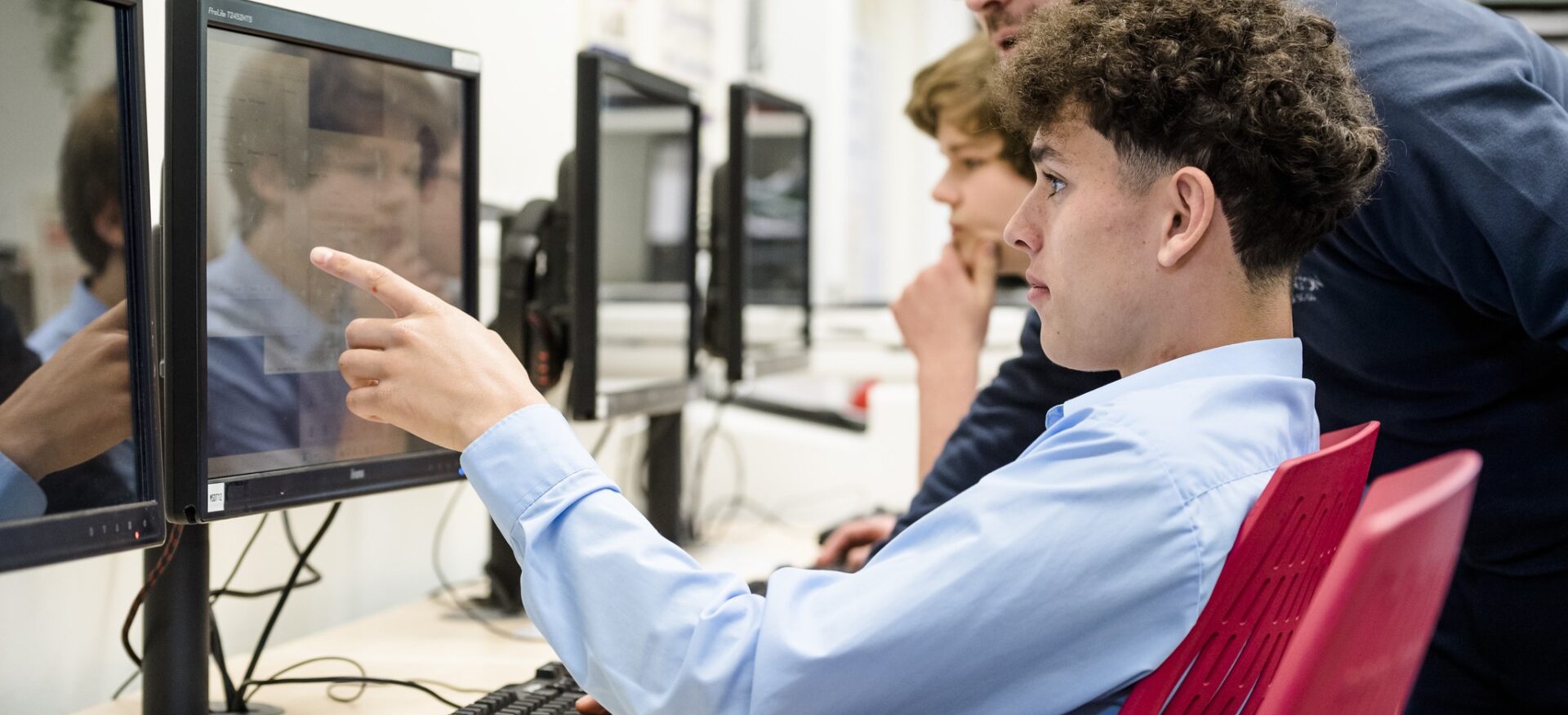
At Burlington House School, ICT is embedded across the entire curriculum — pupils use 1:1 devices as a core part of their learning in lessons across all subjects. Dedicated Computing lessons are offered at KS3, with specialist qualifications available at KS4.
KS3 — Computing (Years 7–9)
Our KS3 Computing curriculum is built on the National Centre for Computing Education’s Teach Computing programme, a structured and well-resourced scheme that develops confident, capable, and creative learners. Topics are sequenced to build knowledge progressively across Years 7 to 9, covering areas such as:
- Programming and problem-solving — pupils work with block-based and text-based languages to develop algorithmic thinking and write working programs
- Networks and the internet — understanding how devices communicate, how the web works, and how to stay safe online
- Data and information — representing, manipulating and interpreting data in meaningful ways
- Computer systems — how hardware and software work together
Alongside the core computing content, pupils are also introduced to broader digital skills — including image editing, spreadsheet use, and media production — which provide a foundation for KS4 pathways and wider digital literacy.
KS4 — Qualifications (Years 10–11)
N.B. These courses may not be offered at KS4 every year – these decisions are taken according to a best-fit scenario for each cohort.
Pearson BTEC Tech Award in Digital Information Technology (Level 1/Level 2)
A link to the specification and awarding body website can be found here.
This practically-focused qualification develops pupils’ understanding of how digital technologies are used in real-world contexts. It is structured around three components:
Component 1: Exploring User Interface Design Principles and Project Planning Techniques
Pupils investigate how user interfaces are designed and learn to plan and manage digital projects effectively. This component is internally assessed through coursework.
Component 2: Collecting, Presenting and Interpreting Data
Pupils explore how organisations gather, manage and use data, developing skills in handling and presenting information meaningfully. This component is also internally assessed.
Component 3: Effective Digital Working Practices
An externally assessed component in which pupils demonstrate their understanding of how digital systems, communication tools, and collaborative technologies are used in modern working environments, alongside awareness of legal, ethical and security considerations.
The qualification rewards practical skill and applied understanding, making it well-suited to learners who thrive when demonstrating knowledge through doing.
Edexcel GCSE Computer Science (1CP2)
A link to the specification and awarding body website can be found here.
A rigorous academic qualification for pupils who wish to develop a deeper understanding of how computers work and how to think like a computer scientist. The course is fully examined and assessed through two written papers:
Paper 1: Principles of Computer Science
Covers the theoretical foundations of the subject, including algorithms and computational thinking, data structures and representation, computer systems and architecture, networks and communication, cyber security, and the social and ethical impacts of technology.
Paper 2: Application of Computational Thinking
Assesses pupils’ ability to apply their knowledge to solve problems, trace and correct algorithms, and demonstrate programming logic. While this is a written paper, it draws directly on the practical programming skills developed throughout the course. We program using Python.

Where can these courses take me?
Learners will develop a combination of academic and practical skills — including logical reasoning, problem-solving, data handling, design thinking, and digital communication — that are valued across a wide range of industries and further study pathways.
Both qualifications provide a strong foundation for progression to Level 3, including A Level Computer Science, BTEC National qualifications in IT and Digital Technology, and vocational pathways in creative and technical fields. Learners will be well-placed for further study or entry-level opportunities in areas such as software development, cyber security, data, digital media, and business technology.
Explore the school


Open Days
To see how our school could support your child, come and meet us at an open day, or explore our Sixth Form to see where the journey can lead.