

Shfliitg the ltteers in tihs snetecne mkaes it vrey hrad to raed at frsit. Yuor biran siltl fnids a wya, btu it tkaes a lto of effrot. Nwo iamgine rdenaig lkie tihs eevry day.
In the classroom, after school, at home, we read thousands of words per day, often without even realising we’re doing it. TV subtitles, social media posts, websites, emails, adverts, street signs, tube maps; almost everything around us requires us to see symbols (letters), decide what sound they make (decode), put them together to make a whole word (blend), and decide on their meaning (comprehend). For most non-dyslexic people, this happens without us even thinking about it; our brains have learnt to automise this process. However, for children, young people, and adults with dyslexia, this can be a life-long struggle.
Understanding dyslexia*.
“Oh, you’re dyslexic, so you can’t read?” I’m sure we’ve all heard the classic line, the assumption that dyslexia is a reading problem, and that’s not entirely wrong. Dyslexia is defined as a set of processing difficulties that affect the acquisition of reading and spelling. These processing difficulties occur in the brain and include;
- Working memory (the ability to hold information in the brain for short periods)
- Phonological processing (the brain’s ability to understand and manipulate sound)
- Processing speed (how fast the brain can organise information)
- Orthographic processing (recognising visual patterns of letters in words)
All leading to the observed difficulties in reading, spelling, and writing which, in turn, impact learning and attainment.
Despite the challenges dyslexia creates, one key thing to remember is that dyslexia is not connected to intelligence. Many children with dyslexia exhibit a ‘spiky profile’. This means that they might score highly in areas such as comprehension, maths, and non-verbal reasoning, but score low in spelling and verbal reasoning. It is also important to remember that people with dyslexia are often highly creative with strong and unique problem solving skills!
Many young people facing the challenges associated with dyslexia struggle with self-esteem, believing that they cannot achieve, and it’s our job as parents, carers and teachers to help them see that they can!

How can dyslexia affect children in the classroom?
For dyslexic students, classes that require note-taking or quick processing of information can quickly become tiring, causing children to lose concentration or motivation. Due to difficulties processing information, children with dyslexia can also struggle to remember information that they’ve been taught, affecting them in tests and exams. Often, children experiencing these difficulties experience low self-esteem or school related anxiety which adds to the effect on learning. However, young people with dyslexia often have strengths in art, design, drama, sports, music, and problem solving. They “see the world differently” and can think outside the box with their “creativity muscle” (In the inspiring words of Benjamin Zephaniah!)
So what might this look like in the classroom?
- Sequencing difficulties e.g. classroom routines, confusion with up/down and left/right.
- Not recognising or confusing similar letters (b/d, p/g, p/q)
- Messy or unorganised written work
- Hesitant reading and spelling difficulties
- Difficulty following the plot of a story
- Work avoidance or tires quickly when completing school work
- Organisation issues e.g. forgetting PE kit or homework
But… this can also look like:
- Creative organisation of notes
- Using songs or drama to remember information
- Creative ‘out of the box’ answers
- Leadership in group work
- Exploring different ideas and solutions
- Resilience
- Drawing pictures linking to lesson content
Dyslexia affects every individual differently, and it is simply impossible to adopt individual approaches for every child. However, there are ways classrooms can be adapted to support dyslexic students and create the ‘dyslexic friendly classroom’ where every young person can succeed and celebrate their strengths.
The dyslexic friendly classroom:
The right environment:
Would you rather work in a bright white room with bold colours, glitter, and fluorescent lighting, or in a room with warm lighting, grey walls, and muted colours? Which room would you concentrate better in? Which room would make you feel most welcome?
Whether home schooling, or in the classroom, creating a supportive physical environment through layout, displays, and visuals will help support dyslexic students to organise information from their environment.
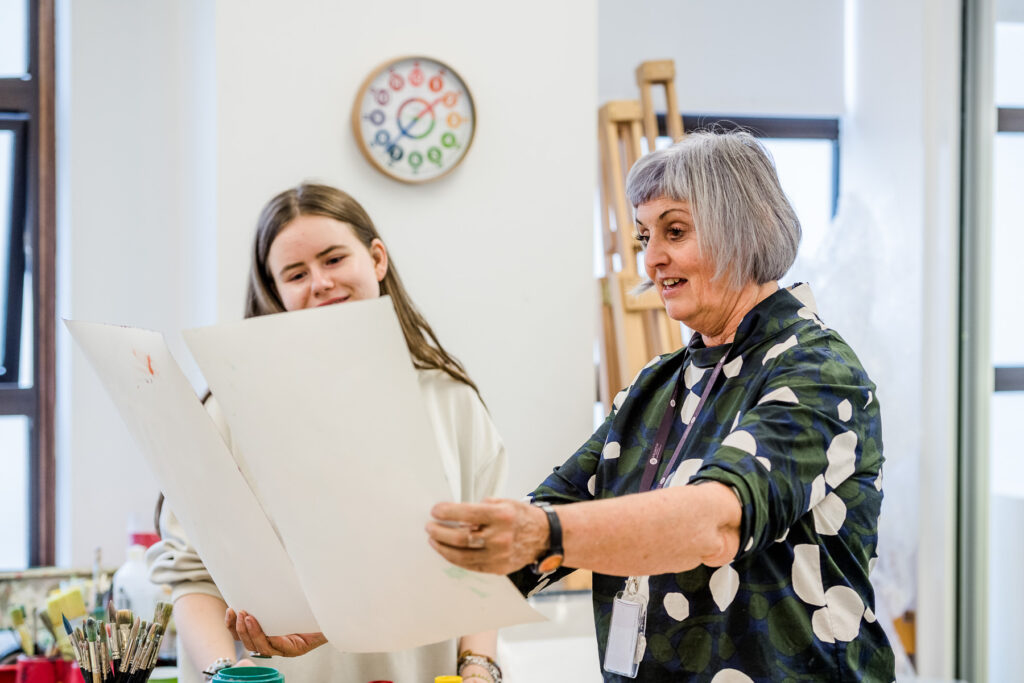
Dyslexic friendly classrooms should be calm, uncluttered, and tidy, with clear visual display boards and organised spaces for pens, pencils etc. Having a calm, organised space supports students to process the information in their environment and feel confident and comfortable entering the classroom. Having clear, set routines with visual timetables and timers also supports children to organise themselves within the classroom, reducing stress and allowing them to focus on learning rather than where to put their bag and coat. There is a wealth of visual timetable templates available online, (and I have linked a few good ones at the end of this article.) Again, visual timetables and classroom routines support all children in feeling calm, settled, and ready to learn – dyslexic friendly teaching is teaching for all!
Display boards are amazing! They add colour, allow you to display children’s work, and are visually appealing to visitors. However. Display boards can often be bright, cluttered, and visually distracting for children, especially children with SEND such as dyslexia. The processing difficulties and classroom anxiety often experienced by children with dyslexia means that display boards can contribute to an over-stimulating environment. Choosing a few, well spaced boxes or pictures with clear headings on a pastel or neutral background will reduce visual clutter in the classroom whilst allowing you clearly display key information that is accessible to all students.
Fact or Fiction: You have to adapt every resource for individual students.
Fiction! The great thing about dyslexic friendly resources, is that all children can benefit from using them – make it the norm! Give all students cream paper, dual coded key word sheets, and scaled scaffolding activities (purple = easy, yellow = tricky etc). Your dyslexic students may be among your highest achievers and the adapted resources you give don’t need to be exclusive. In addition to resources, your whole class teaching strategies can support dyslexic learners to access the same work as their peers, without them feeling singled out or ‘different.’
Dyslexia-friendly teaching and learning strategies
Dyslexia friendly teaching is good teaching for all. Teaching dyslexic students is not so much about adapting to individual needs, but rather teaching in such a way that adaptations are the norm. All students can benefit from dyslexic teaching because it is clear, structured, scaffolded, and multi-sensory.
Multi-sensory teaching:
Does not mean throwing water balloons at letters to spell words (although that would be brilliant!) In practice, multi-sensory teaching involves things most of us do every day: Using our senses to explore, understand, and communicate knowledge.
For dyslexic students, barrages of small print text that they’re expected to read, memorise, and re-gurgetate, would probably be their worst nightmare. By the time they’ve managed to decipher the letters and words on the page, their brains are exhausted and actually understanding the content is the last thing they’re thinking about. But nor is this an effective teaching method for any student.
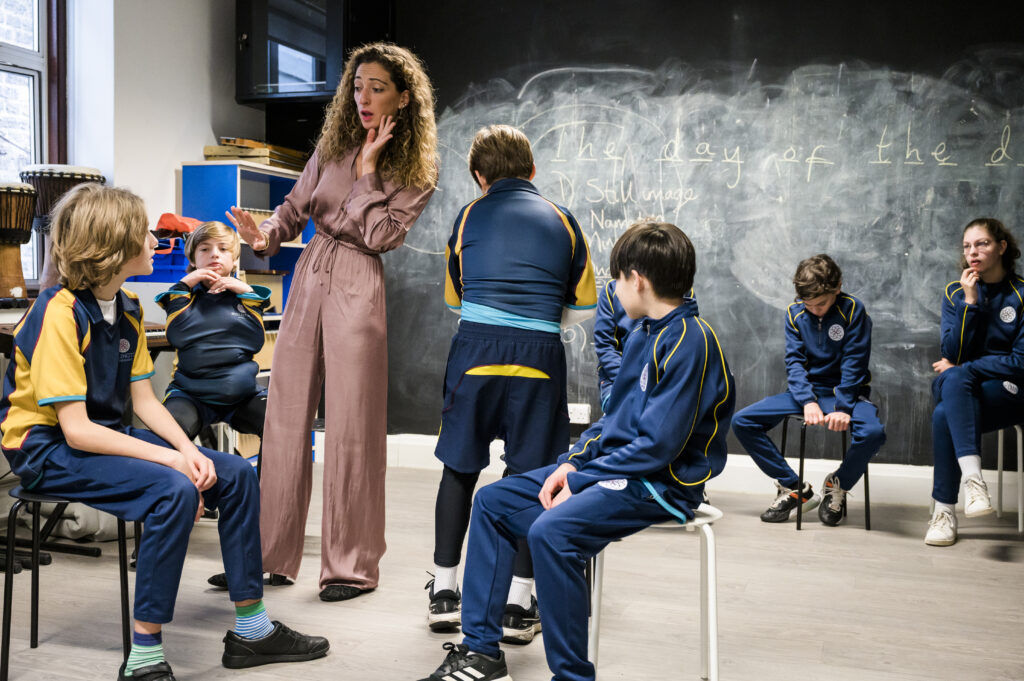
Instead, breaking up lessons with practical, engaging activities such as; mini whiteboards, competitions, physical movement, and games can take the pressure off and allow dyslexic students to express their understanding and celebrate their strengths. Multi-sensory teaching improves engagement and supports all students to participate in learning with ‘easy win’, low stakes tasks. Combined with clear instructions presented verbally and visually, all children can feel confident to participate in lessons and engage in learning.
Dual coding involves using images to support the understanding of written content. For dyslexic students, they can use the accompanying images to check they have read and understood the text correctly, and so can their peers! Dual coding supports embedding information in the long term memory through forming additional connections in the brain and can be key to supporting dyslexic students with severe reading difficulties – struggling with reading does not mean they will struggle to understand the concepts you’re teaching, they just may need to express their knowledge a little differently.
Clear instruction and scaffolding:
In addition to multi-sensory teaching (and arguably the most important teaching method!) clear instruction and scaffolding ensures that the class stays together, and learns together. All children benefit from clear routines and expectations; displaying work in clear formats, having set routines for lessons, and outlining clear expectations for work with step-by-step instruction, not only support all students to remain on task, but reduces the demands on working memory for dyslexic students who may struggle to process, organise, and prioritise tasks.
Scaffolding is the process of ‘stepping up’ to more difficult tasks – you can’t expect students to reach the roof without one. Sometimes scaffolds can be individual; additional support, example problems, or step-by-step guides. However, whole-class scaffolding should always be applied when teaching a new topic. We’ve all seen the handwriting books (with dots in the shape of letters). When you first start drawing the letter, all the dots are present and you follow them. Then, the dots start to disappear and, suddenly, you’re writing the letter ‘a’! This is probably the first example of scaffolding children encounter at school, but the idea applies right through their education journey.
Dyslexic students may benefit from having scaffolding for longer to support their processing of new information, but also to build their confidence. This doesn’t mean they are learning slower or haven’t mastered the content – they just may need a little more support than their peers.
Whole class scaffolding can be;
- Model answers
- Sentence starters
- Discussion groups
- Whole class reading
- Low stakes games/challenges (multi sensory!)
- Completing one part of a task at a time
- Optional check ins (Also develops metacognition* and self-advocacy)
*Metacognition is a child’s ability to understand their own learning needs, when they need help, what their strengths are etc.
Literacy Support in a Dyslexic-Friendly Classroom
One feature of the dyslexic friendly classroom that can cause tension is ‘literacy support’. As a literacy support intervention teacher, I find myself teaching phonics, spelling rules, and punctuation to 16-18yr olds, something they are open to 1:1 but definitely wouldn’t appreciate in a whole class scenario!
Unfortunately, in all lessons, students will eventually have to produce written answers. For students with mild dyslexia, they may be supported through word banks, pre-teaching of vocabulary with spelling practice (for the whole class!), and whole class reminders of spelling rules/strategies with model answers.
However, for students with severe writing or spelling difficulties, further support may be needed so they can display their understanding. Access to assistive technology such as laptops, text-to-speech, spellcheckers, and diction software are incredibly beneficial for students and adults with dyslexia. In my lessons, I always like to model myself using these technologies to the class to encourage students that benefit from assistive technologies to embrace them.
Understanding and embracing differences is always a tricky topic to navigate with young people. A lot of students don’t want to appear different than their peers – understandably! Gentle encouragement, building relationships, and working with parents/support staff is often key to children feeling comfortable in the dyslexic-friendy classroom.
Literacy support, what not to do:
Literacy support does not mean correcting every single spelling mistake. I’m not dyslexic myself, however spelling has always been challenging for me. I remember getting work back absolutely covered in red ink… never mind that the work was actually quite decent, all I could focus on was what I’d done wrong.
Often, dyslexic students will be receiving additional support sessions with trained intervention staff – meet dyslexic students where they are and focus on the positives!
Liaising with their support staff can be crucial to understanding what a child should be able to do independently, what their current goals are, and how you can support them to progress. If a child is still working on reading sight words, correcting every single spelling mistake they make is going to do more harm than good. Gentle encouragement towards their current goals is more than enough.
Building Confidence and Collaboration:
It takes a village to build a dyslexic friendly classroom: SEND students have a team of people around them who must work together effectively to support their learning, emotional wellbeing, and progress.
Teachers: Understand individual student needs and create a dyslexic friendly classroom as the norm: dyslexic teaching is good teaching for all!
Support staff: Build strong relationships with the young person, understanding their needs and gently encouraging support but allowing the child to build independence, again liaising with support staff for strategies/current goals.
Specialists: Provide diagnostic support, individual strategies, and support teachers to create the dyslexic friendly classroom.
Parents: Work with school staff, advocating for their child’s needs and building their confidence through reinforcing learning at home. Celebrate the small wins and big successes equally and gently encourage the use of assistive technologies. Provide lots of opportunities for reading practice (Barrington Stoke are a fantastic dyslexic-friendly book company!) and remind students of their strengths – we can’t all be as awesome as dyslexics!
The Dyslexic Friendly Classroom: A summary
Key features of the dyslexic friendly classroom:
- A calm, organised, and welcoming space (muted colours, routines)
- Dyslexic friendly resources for all students (cream paper, dual coding, read aloud)
- Multi-sensory teaching methods (dual coding, games, drama, discussion)
- Clear instructions and routines (with visual timetables and practice)
- Whole-class scaffolding (discussion groups, model answers, sentence starters)
- Access and encouragement to use assistive technologies (laptops, speech-to-text)
- Effective collaboration with support staff
- Meet them where they are and celebrate the strengths!
These adjustments do not lower academic standards; instead, they remove unnecessary barriers to learning and allow students to demonstrate their true abilities.
Many young people facing the challenges associated with dyslexia believe that they cannot achieve: It’s our job as parents, carers, and teachers to help them see that they can!
*Dyslexia can only be diagnosed through an assessment completed by a licensed practitioner holding an APS (Assessment Practicing Certificate). If you are concerned your child may have dyslexia, contacting the school is the best way to start! Your child’s head of year, English teacher, or SENDco will be able to point you in the right direction.
Resources:
Visual timetables:
https://www.sensationall.org.uk/visual-timetables/
Barrington Stoke: https://www.thedyslexiashop.co.uk/collections/barrington-stoke?srsltid=AfmBOorg6kx3mR6wYDX6v2DTSQQC_GJ_ywDTjXPq9jVN4it_fruz6adj
Bibliography:
https://www.bdadyslexia.org.uk/dyslexia/about-dyslexia/what-is-dyslexia
https://www.theguardian.com/commentisfree/2015/oct/02/young-dyslexic-children-creative
https://www.sciencedirect.com/topics/psychology/matthew-effect
https://educationendowmentfoundation.org.uk/education-evidence/guidance-reports/literacy-ks2
https://louiseselbydyslexia.com/self-regulation-and-metacognition-for-learners-with-dyslexia/